
Various articles

The Waco Bros:......THEY'RE BAAAAAACK.....

"In a world of overly serious, self-righteous post-modern country-rock dweebs, the Waco Brothers are a blast of fresh air. While other rockers approach country with tip-toe-through-the holy-classics restrain, the Waco Brothers do a shit-kick dance right through the music's past." Guitar World

Just when you thought it was safe to like tepid country rock crapola and third-rate, angst-ridden indie posturing again, your comrades at Chicago's own Bloodshot Records -- the nation's sole purveyors of Insurgent Country music -- are here to give you what you really need: a careening three-chord frontal assault, devilishly gleeful "fuck-it-all" delivery, glorious, down-in-flames, beer-logic despair, and a heart of solid coal. Ladies and germs!

Presenting -- Do You Think About Me -- the new cd from THE WACO BROTHERS.

When we last heard from the Wacos, they were swinging a "Nine Pound Hammer" on Bloodshot's Straight Outta Boone County compilation in the company of Robbie Fulks, Hazeldine and Holler, to name a few. Now the cheese stands along -- witness ten all new-songs that piss on and subsequently blur the lines between punk and country. From the horn-driven album-opening title number (call it "Exile on Waco Street"), to the blitzkrieg cover of Neil Young's "Revolution Blues" (they ain't called the Waco Brothers for nothin'), to weaving, whiskey-addled waltzes and swinging, spooky-ass barnburners --Do You Think About Me is guaranteed to rock the union hall. Some of these tracks are spilt-over from the acclaimed To The Last Dead Cowboy and Cowboy in Flames sessions - songs too good to die -- and be sure to listen out for our old pal Tom Ray of The Bottle Rockets whomping the double bass on a few songs. All together its 31 minutes of Waco greatness -- where country spirit beats the hell out of country form --

Introducing the hardest drinking men in show business:
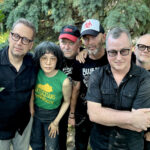
Jon Langford (Mekons), Steve Goulding (Mekons, Poi Dog, Rumour), Dean Schlabowske (Wreck), Mark Durante (KMFDM, RevCo), Alan Doughty (Jesus Jones), and Tracey Dear (world's greatest living Englishman).

Do You Think About Me delivers a swift kick in the bread basket to the chickenshit and complacent, and serves as a moral centerpiece for the whole Insurgent Country movement. Keep ahead of the mounting, smoldering wreckage and don't let the revolution pass you by...

© The Press Network Go to the top

By -Noah Mallin

From: A site with sound

The Waco Brothers are Bloodshot Record's latest and most high profile fussilade in their self-described "insurgent country" movement. As near as I can tell, insurgent country bears some relation to what used to be known as cowpunk. Most importantly, The Mekons' Jon Langford (or Johnboy as he prefers to be known in his Waco guise) sings and plays guitar in The Wacos and insures that their second album COWBOY IN FLAMES keeps one foot on Hank Williams Sr.'s grave and the other one on Garth Brooks' neck.

In fact, much of the album resembles The Mekons' excellent mid-80's country-influenced work such as FEAR AND WHISKEY, but with more energy and somewhat greater chops. Langford's singing and lyrics still have their biting intensity, and fellow Mekon Steve Goulding keeps the drums a-shakin' with his unerring rhythm and solid swing.

Also singing and playing guitar is ex-Wrecks member Dean Schlabowske, whose voice has an appealing Jaggeresque tone. In stunning heresy, all of these country commandos currently hail from the Chicago area; even more incongrously Moulding, Langford and basssist Alan Doughty are natives of Britain.

It is good to report that one of our end-of-the-millenium phenomena still holds true in this case: side projects can be as good as, and sometimes better than, the main band (hello Varnaline, Folk Implosion, Portastatic, Firewater) COWBOY IN FLAMES starts with one of the Waco Brothers' best songs, the driving, rollicking "See Willy Fly By",. "Waco Express" introduces Schlabowske's appealing twang and features some fine pedal steel by Mark Durante. "Take Me To The Fires" is delivered revival-style and is very similar to The Clash's "Judgement Day." "Dollar Dress" , adds some pleasing south-of-the-border flavor, while "Out In The Light" sports a driving Bo Diddley beat. The covers are also a hoot including a red-hot version of Johnny Cash's "Big River"

The only real downside to COWBOY IN FLAMES is the hard to read track listing on the back cover of the CD and the bassist's previous life as a member of future trivia-question answer Jesus Jones. For all of you who are sick of explaining the difference between real country and the ersatz Billy Joelisms spouting from Nashville lately, this unlikely mix of pasty Brits and Yankees may be your salvation. Go to the top

Waco Brothers prove more punk than country

TT the Bears, Cambridge, Mass., Feb. 8, 1997
By Jeffrey B. Remz

CAMBRIDGE, MASS. - The final song of the Waco Brothers new disc, "Cowboy in Flames," is appropriately enough entitled "Death of Country Music."
The Chicago-based band, comprised of band members who gained fame, but not necessarily fortune with other bands, sings in the opening song that the death "rattles around the planet...where the dance floor's overcrowded and the music's getting louder/People do some breathing/while they're cheating death."
Clearly an indictment of the current state of country where the dance floor craze neglected the pillars of country like Jones and Cash, who are cited in the song as well. No wonder the Wacos were all dressed in black.
Whether The Wacos are the successors to the mantle of Jones and Cash may be debatable, but they did prove before 200 plus they may be more the successors to the mantle of another Jones - Mick - and his former seminal punk band, The Clash.
The band's one-hour set proved to be far more punk than country, although the Wacos did show their country leanings towards the end ("Do What I Say" and several covers). The band clearly rocked far harder than they do on either of their two albums.
Not to say that is bad. Far from it because this is a band that seems entirely comfortable in either sector.
Jon Langford of British band, The Mekons, is one of the lead singers along with Dean Schlabowske, who recalls Elvis Costello visually and Jason Ringenberg of Jason & The Scorchers vocally ("Waco Express"). Each acquitted himself well on vocals throughout the evening with Langford's the rougher hewn. Mandolinist Tracy Dear also turned in a good performance on vocals. Sometimes, however, the vocals were mixed too low.
A few worthy covers - "White Lightning," also on the new disc, and "I've Got a Tiger By the Tail," penned by Buck Owens and Harlan Howard - were well done.
Like The Clash, the Wacos don't shy away from politics, something country generally has stayed away from. And while many in country possess conservative values, the Wacos stand squarely on the left. "Plenty Tuff Union Made" is an ode to the power of unions and working folks.
Drummer Stephen Goulding, former member of Graham Parker's The Rumour, bassist Alan Sprocket, formerly of the British band Jesus Jones ("Right Here, Right Now"), Mark Durante, of KMFDM on pedal steel player all possessed the musical skill to pull off the punk/country combo.
Sprocket acknowledged after the gig he wasn't much into country prior to being part of the Wacos, but he said he has grown to like it.
Go to the top Following the show, Dear asked if it was country. "Well, no it was more punk," he was told.
Punk may not really be the future of country music, but if the Wacos adhere more to country, they could be one of the bands spearheading the growth of country as we once knew it, but with a decidedly modern twist.
(FROM CST)


The strange motives and skewed romance behind the Waco Brothers

By Bill Sacks


Waco drawingThey are an unlikely group of suspects, these six; three Englishmen, one Irish, one Minnesotan and one from Chicago, all living there now, the majority of whom have come to an understanding of what it might mean to "play country" well into their musical lives.

They insist that their collective work as the Waco Brothers began as a cover-band lark, as a way to pay for weekend nights out at the bar, and that they will continue to work in the tradition only so long as it remains their pleasure.

But it becomes increasingly clear, when each man discusses his own musical past and present ambitions, that it is their sense of the ethical bedrocks of country music, duly separated from the machinery of the Nashville and Bakersfield studio systems, which makes the full seriousness of their recent efforts plain to anyone willing to listen.

What the provisional investments of their two Bloodshot recordings (1995's "...To The Last Dead Cowboy" and the newly released "Cowboy In Flames"), and their spate of live gigs (most of which have been played around their home base of Chicago) reveal is that they are dedicated to the prospect of bringing a liberating topicality to a style routinely experiencimg near-suffocation at the hands of its memorializers.

On the evening of Thursday, February 20, the streets of downtown St. Louis are glazed with rain. The loft above The Side Door, which functions as a make-shift dressing room with ramshackle couches and rubber tarps for walls, is thick with steam-heat and the smell of beer, and Jon Langford, the Waco's guitarist and head piss-taker, has something on his mind.

"Would you mind telling me why the f--- Hank Williams doesn't get played on American radio? I'm talking about full-powered FM radio here, not some late-night signal from out of someone's basement. Is there something wrong with Hank Williams? Is he not pretty enough?"

This, from a songwriter who imagines his band as ruddy cannibalizers of traditional country's musical corpus.

Langford has spent the past 20 years in an uneasy relationship with popular music's recent past, first as a founding member of the British agit-punk collective known as the Mekons, then with the equally thorny Three Johns and back to a rebuilt Mekons in the mid-'80's where he first vested his interest in country music on record.

Jonboy When Langford talks about the possibilities he envisions for the Wacos, he speaks in terms of historical focus and a reckoning with the misplaced spirit of country's early innovators.

He ventures this answer to his own question: "I think that people take to the idea of liking Hank Williams, of caring about music which they've been told has some grand historical importance, but there seems to be a well-conditioned aversion in this country to listening to someone who lays out unsentimental, naked feeling the way he did. If there's one thing that all the members of this band agree on, it's that the songs we write and the way we play should be in the spirit of a Hank Williams or Bob Wills - do American kids know that Bob Wills was making rock & roll music on the Texas honky tonk circuit in 1928?- in that we're going to damned well be raw about it."

That rawness translates itself on stage into performances marked by wry confrontational moments, when songs like "Dollar Dress" and "Plenty Tough - Union Made" pointedly address a mainstream culture which denies the complexity of work-a-day existence, often smothering it with panderances to knee-jerk nationalism.

The Wacos insist on something more intensely personal, more politically complicated; their work speaks in voices which that mainstream seems dead set on drowning out.

"It's important for me to have a sense of history behind my work these days, to know that there is this whole genre of music which, at its best, made room for people who didn't flinch from hard subjects and weren't afraid to be self-effacing, either. I mean, there are kids out there making techno records or whatever, who think the way I did when I was just starting out with the Mekons - that what they're doing has no antecedents, that this is their 'year zero' and they're making everything up as they go along."

"And a certain amount of that is healthy - it keeps you from feeling that some subject is taboo when it shouldn't be, or that you'll be shat on if you take musical risks - but it's also an illusion. Right now, or at least since (Bloodshot Records founder) Nan Warshaw talked us into making a full-length record and we wrote our first originals, that it's not an illusion I need in order to contribute something fresh. As long as we can continue to find pieces of the country music past which make sense to us and what we want to do as a group, we'll continue."

Dean Schlabowske, who shares guitar and vocal duties with Langford and comes to the Wacos after several years of leading the caustic post-punk group Wreck, explains the cultural logic of the recent country turn:

"When I first started playing, I hung around with people who always seemed to have a Hank Williams or Johnny Cash record tucked in with their punk and new wave records. There were plenty of people (around Minnesota and Wisconsin) who saw country music as the antithesis of punk, who saw things in terms of regional identities instead of taking the musicians on their own terms. The people whom I played in bands with who cared about Hank Williams heard the anxiety in his songs and recognized some part of it in themselves, and, of course, there was his self-destructive streak..."

"I've really liked exploring the margins of country music because it's made me open up as a writer; my old band was all about hard-edged aggression, and now I'm able to approach new songs with different levels of intensity."

A fine example of his new found touch is "Dry Land," a song Schlabowske sings about romantic alienation which brings out the subtleties in the Wacos' musical interaction without compromising their ultimate strengths: boozy harmony, a strong rhythmic core (thanks in large part to drummer extraordinaire Steve Goulding - formerly with Graham Parker's The Rumour and "our ringer," Langford says) and a dedication to the realities of the blue collar experience.

"Trying to create something which speaks to the most honest music which has come out of Nashville over the past 20 years or so is what this band is all about," says Tracey Dear, the Wacos' mandolinist and their most consistently compelling vocal presence.

"When I think about what I'd like to do with this band, I flash back to the best records people like Nanci Griffith and Rosanne Cash have made, and the unaffected personality they put into their work is what I'd like to have us put over. We're headed off to our first gig in Nashville tomorrow, and there's nothing I'd rather do than go there and show people a side of country music they've never really seen before - if I can take what I know from my background in Irish music and add that to all the different revisions of country that Jon and Steve in particular have been working on for years now, I think we can pull it off."

The proof is in the shows the Waco Brothers put on: later that night, with Langford roaring hysterically from his beer, each of the band's lead voices steps forward to put out a series of impassioned pleas on behalf of a musical legacy that unconditionally demands an inventive subversion of banality and hopelessness.

As they blast their way through a version of "Wreck On The Highway" which replaces the Dorsey Dixon original's sanctimonious tone with seething rage, they shows themselves as a group for whom the commitment to giving the music back its bad conscience is a deep-seeded conviction.

They offer up to the tradition the promise of attracting a new audience drawn to that conscience as an antidote to Music City cliches, in which there might lurk new voices whose own emotional rawness explodes expectations in precisely the way Wills, Williams and Cash once did. Jeffrey B. Remz, Editor & Publisher

Go to the top